Cafcass / GAL / Court-Psychologist Interview Prep Brief
The court-appointed officer's report is often the single most influential document in a child-arrangements case. Walk in cold and you're at the mercy of whatever framing was planted before you arrived. Walk in prepared with this brief and you reshape the conversation.
This template is what you produce for yourself ahead of the interview — and selectively share parts of it with the officer if they ask.
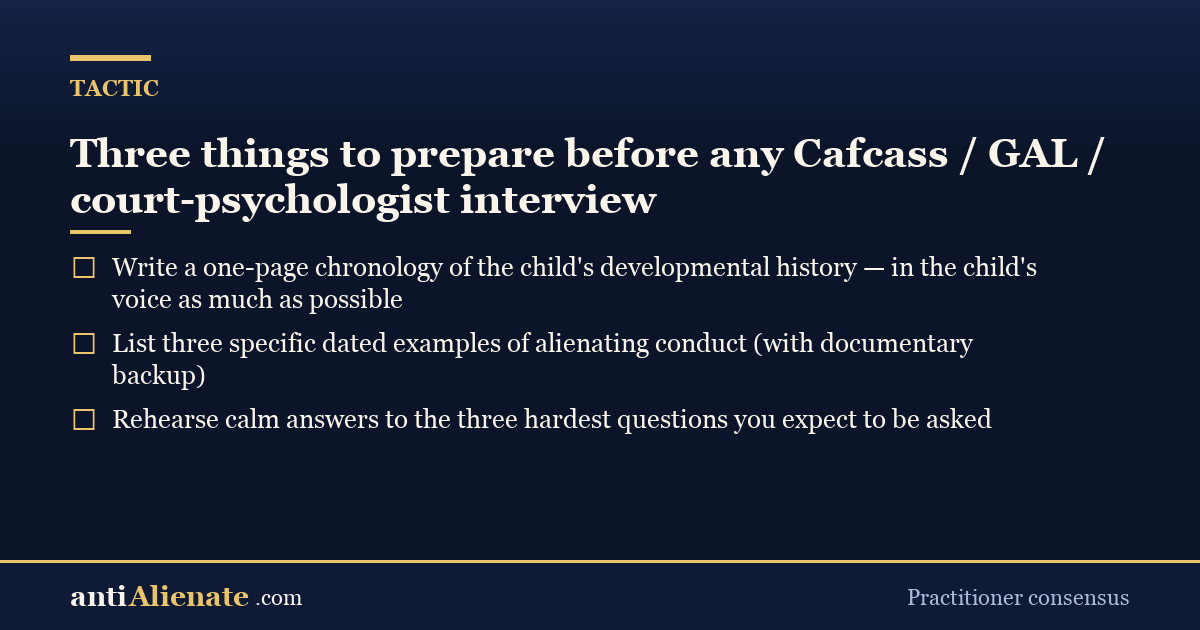
Part 1 — One-page child chronology
In the child's voice as much as possible. Aim for one page. The officer reads many of these; brevity wins.
[Child's name]'s story so far
[Child] was born [date] to [parents]. From [year] to [year], they lived with both parents in [location]. During this period, [child] was [school, hobbies, key relationships, things they loved doing with each parent]. Their attachment to both parents was [evidenced by: specific moments, photos, school reports, etc.].
In [year], the parents separated. From [date] to [date], a parenting arrangement was in place under which [child] [spent X days with each parent / similar]. During this period, [child]'s observable wellbeing was [stable / increasing strain — give specific markers: school reports, doctor notes, third-party observations].
From [date] onwards, a shift occurred. [Specific change: contact reduced from X to Y, child began to refuse handovers, school reported behaviour change, etc.]. The shift coincided with [observable circumstance — moving in with a new partner, school change, etc.].
Today, [child] is [age], in [year group at school], and lives [arrangement]. [Specific recent observation of the child's wellbeing and functioning, ideally from a third party.]
Part 2 — Three specific dated examples of alienating conduct
Each one anchored in the evidence file.
Example 1 — [date]: [What happened, in two sentences. What's the documentary backup? Reference exhibit number.]
Example 2 — [date]: [Same structure.]
Example 3 — [date]: [Same structure.]
Pick three that are unambiguous and have third-party or documentary backup. Don't try to cover everything — three solid examples beat thirty he-said-she-said.
Part 3 — Anticipated difficult questions
Rehearse the three hardest questions you expect to be asked. Write calm, accurate answers.
Q: "Why do you think the child doesn't want to see you?"
A: [Calm, factual, non-attacking. Acknowledge the child's reluctance is real. Frame it in terms of the conduct evidence rather than calling the other parent names. Example: "From [child]'s perspective right now, contact with me has been associated with conflict at handover, and they're protecting themselves by avoiding it. The evidence I've documented suggests that conflict has been generated by [specific conduct, not labels]. I want [child] to feel safe, which is why I support [the specific intervention you'd like the officer to recommend]."]
Q: "Are you saying the other parent is alienating the child?"
A: [Describe conduct, not labels. "I think the pattern of conduct I've documented — [the three specific examples above] — is consistent with what the literature describes. I'd rather the court draw its own conclusion from the conduct than rely on a label."]
Q: "What outcome would you like?"
A: [Specific, child-focused, proportionate. Not "I want full custody." Better: "I would like the court to consider [therapeutic supervised contact / a structured graduated reintroduction / a fact-finding hearing on the specific conduct], because the evidence suggests that's what [child]'s wellbeing requires."]
Part 4 — Frameworks the officer should know
Worth mentioning if the conversation invites it:
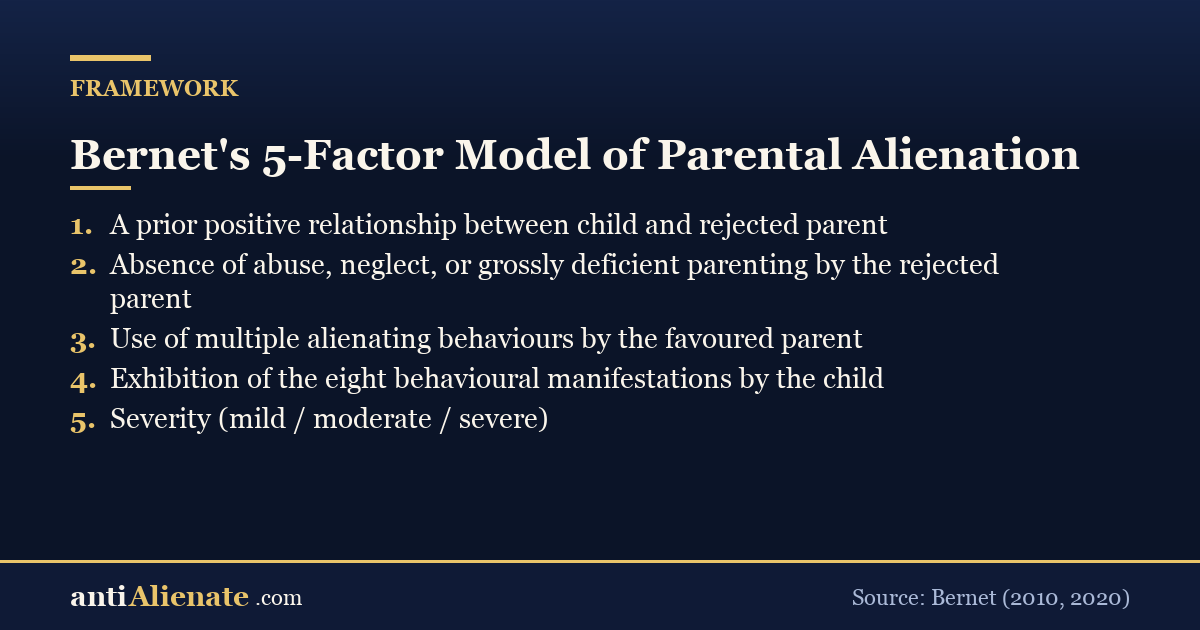
- Bernet 5-Factor Model — to distinguish alienation from estrangement.
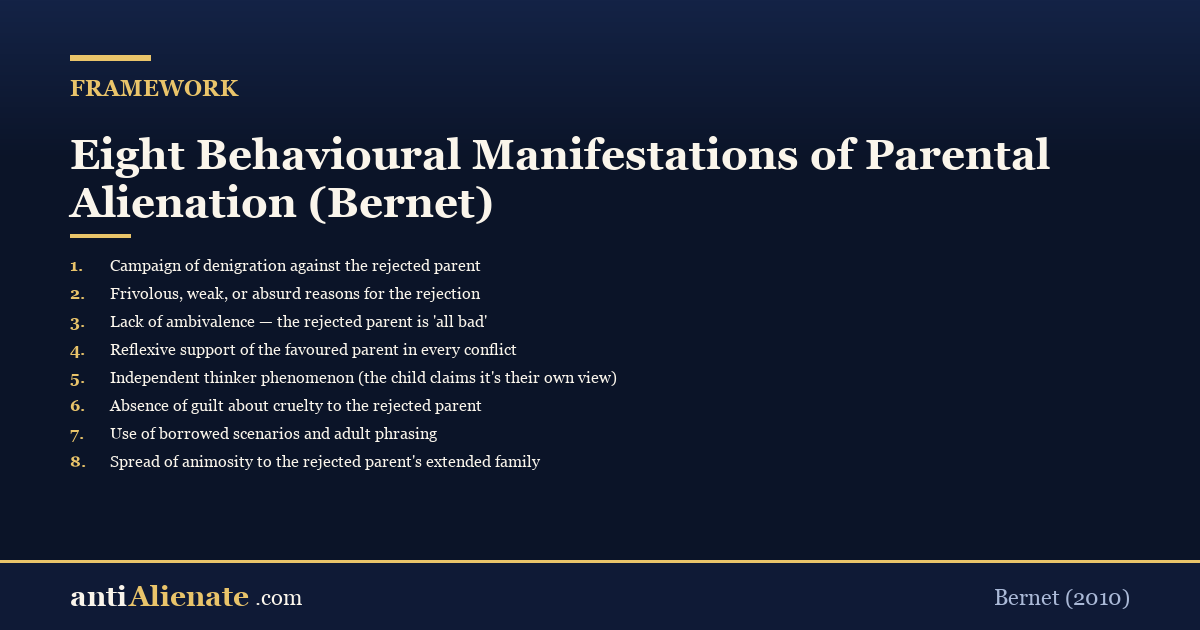
- Eight Behavioural Manifestations.
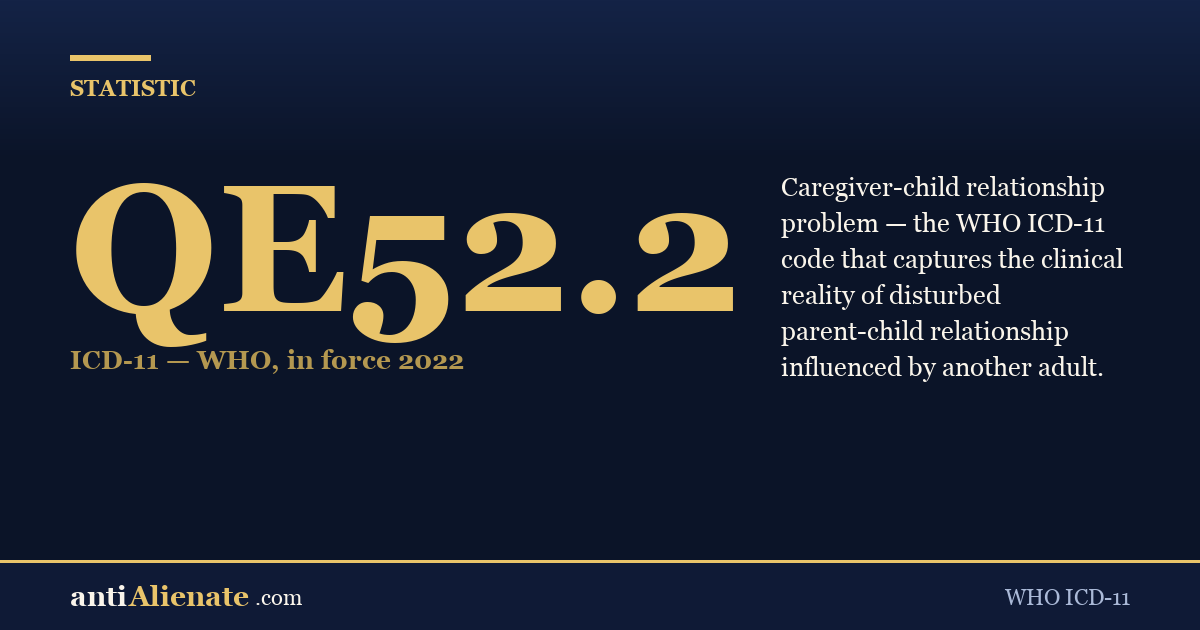
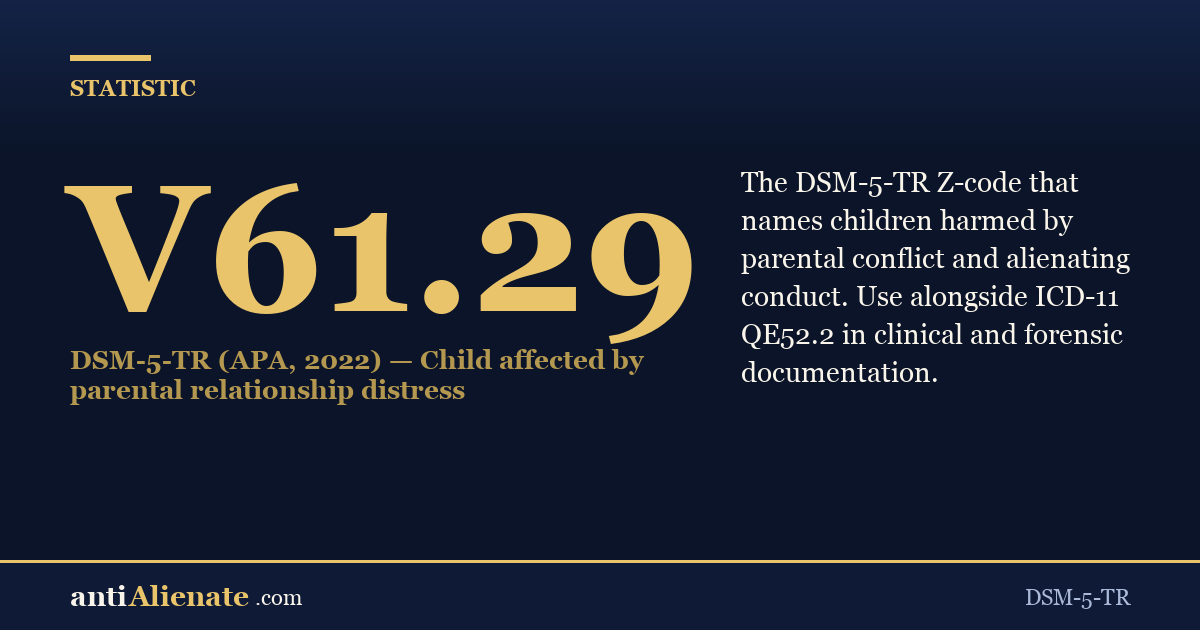
- ICD-11 QE52.2 and DSM-5-TR V61.29 — the clinical codes.
Bring with you (physical)
- A short folder with the three example exhibits.
- The one-page chronology.
- A pen and notebook to take notes during the meeting.
- Tissues. (Yes, really.)
Related
Disclaimer. This is a starter template, not legal advice. Adapt to your jurisdiction and case facts. Have a licensed practitioner review before filing. Statutes and procedural rules vary and update — verify against primary source.
— AntiAlienate.com · CC BY 4.0
Sources & authoritative references
Referenced in this page:
Topic baseline (independently verifiable):