Astreinte Application — Template
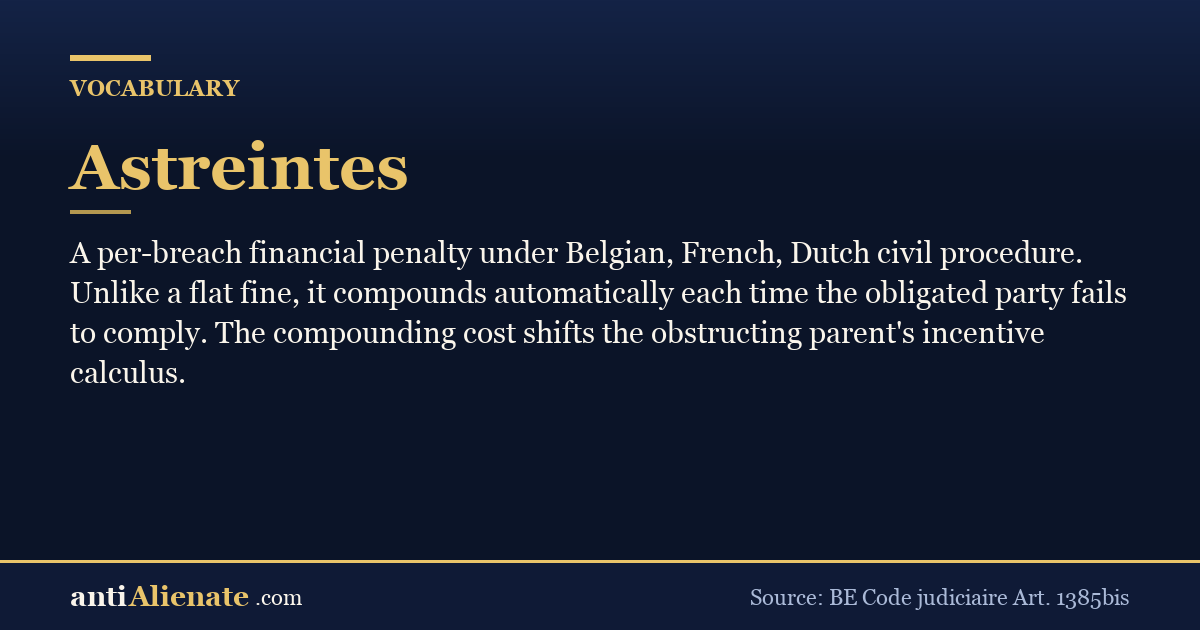
An astreinte is a per-breach financial penalty that compounds automatically. It is significantly more effective than flat fines because the cost to the alienating parent grows with each new breach — without you having to re-litigate.
The mechanism exists across Belgian, French, and Dutch civil procedure. Many family-law practitioners under-use it; you may need to ask explicitly.
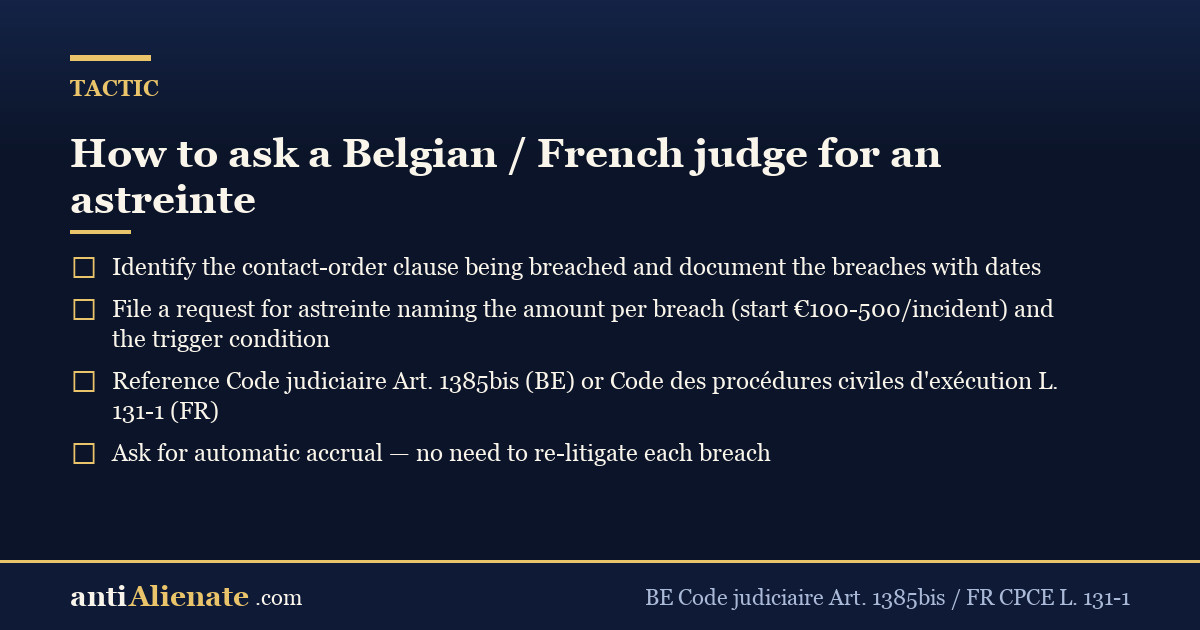
The four-step procedural ask
Step 1 — Identify the contact-order clause being breached
Quote it verbatim. Example (BE): "De vader heeft recht op contact met het kind elke woensdagavond van 17h tot 20h en elk tweede weekend van vrijdagavond 18h tot zondagavond 18h."
Step 2 — Document the breaches
Use your contact log. For an astreinte motion, you want a minimum of 5-10 documented breaches over a 2-3 month window. Each breach should have a date, the verbatim refusal, and a documentary source.
Step 3 — File the astreinte motion
The request typically includes:
- The exact clause being breached (Step 1).
- The schedule of documented breaches (Step 2).
- The proposed astreinte amount per breach (typically €100-500 per incident — adapt to local norms and the obstructing parent's means).
- The trigger condition (e.g. "per missed handover not justified within 24 hours by a treating medical professional's note").
- The cap or duration (some jurisdictions require an upper limit).
Step 4 — Reference the statutory basis
| Jurisdiction | Statutory authority | Notes |
|---|---|---|
| Belgium | Code judiciaire Art. 1385bis–1385nonies | Cour de cassation has confirmed astreintes apply to contact orders. Pair with a request that the President of the Tribunal de la famille set the rate. |
| France | Code des procédures civiles d'exécution (CPCE) L. 131-1 to L. 131-4 | The juge de l'exécution sets and liquidates. Often paired with Art. 373-2-6 Code civil contact-obstruction findings. |
| Netherlands | Wetboek van Burgerlijke Rechtsvordering (Rv) Art. 611a–h | The dwangsom (Dutch equivalent of astreinte) is granted by the rechter who issues the underlying order. |
Why it works
Unlike a flat fine (which the alienating parent often calculates as "the cost of doing business"), the astreinte:
- Compounds — each breach adds another penalty.
- Accrues automatically — no need to file a fresh contempt motion per breach.
- Liquidates on demand — the recipient parent applies for liquidation when the accumulated total is large enough to enforce.
- Shifts incentives — the obstructing parent quickly faces an arithmetic problem they can't argue out of.
Practical template — request paragraph (BE example)
"Het Tribunal de la famille wordt verzocht, op grond van artikel 1385bis van het Gerechtelijk Wetboek, een dwangsom op te leggen van €250 (tweehonderdvijftig euro) per inbreuk op artikel [X] van het vonnis van [datum], met automatische accumulatie en zonder noodzaak van afzonderlijke procedure per inbreuk."
Translate / adapt to your local language and procedural norms.
What this is not
It's not punishment for past breaches (use ordinary contempt for that — see your jurisdiction's contempt mechanism). It's a forward-looking deterrent that makes future breaches arithmetically expensive.
Related
- Astreintes — vocabulary card
- Astreintes filing — tactic card
- Belgium jurisdiction page (TODO link when /jurisdictions/belgium.md added)
- France — Cour de cassation line on contact obstruction
Disclaimer. This is a starter template, not legal advice. Adapt to your jurisdiction and case facts. Have a licensed practitioner review before filing. Statutes and procedural rules vary and update — verify against primary source.
— AntiAlienate.com · CC BY 4.0
Sources & authoritative references
Topic baseline (independently verifiable):